Film Photography and the Analog Mind
I suppose it's quite ironic that my choice of medium for this essay is digital, but I chose it for its convenience. It is that very convenience that my mind so readily and hastily detests in most aspects of life. I am a computer engineer by trade, and my job is to increase convenience and ease of use on the platform whose development I lead. Most all of my working hours are used to eliminate friction points, smooth out workflows, and make the system easier to use and administrate in the field for the average Joe. I deeply enjoy this occupation and find great fulfillment in it; yet it is also the antithesis of how I feel about my own life to an extent.
I am a man with sundry hobbies and divers distractions; I love writing letters with quill and inkwell by the light of a beeswax candle, sealed with wax and mailed with the oldest looking postage stamps I can find at the post office. I don't use it nearly as much as I should, but I have an RCA stereo console from the mid 1960s and a small collection of vinyl to use it with. My personal library that sits in piles on my floor is filled by a majority of antiquarian books which I purchase at thrift stores and book stores whenever I see them. Perhaps my favorite hobby, though, is film photography. I purchased my first film camera about ten years ago at a local auction. It was a Minolta XG-9, which of course did not work; I disassembled it and was amazed at the amount of mechanical engineering within its body. In an age where every adult in modern society carries a camera in their pocket, the humble film camera called to me nearly by name.
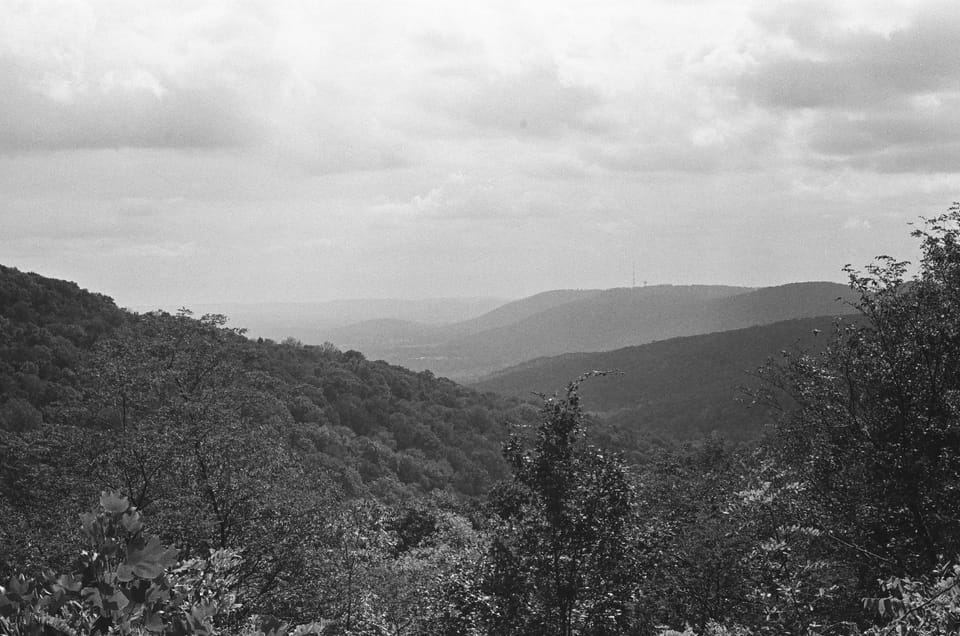
A few years passed by in which I dabbled with the hobby from time to time; each period with a deeper understanding of how to properly utilize the gear to achieve a desired outcome in a variety of environs. I started to become interested in the ancillary practices of development and scanning, and eventually I was shooting pictures and going home to my humble barracks room in Cherry Point, North Carolina where I would then develop the film in the confines of the restroom shared with the adjoining room. I spent hours practicing loading a roll of film into a development tank in the darkness and devising methods to control the temperature of the developing chemicals with the few resources I had available to me in the barracks. I came to understand the beauty in the ritualistic processes of analog activities; I grew to love the work and subsequent reward of a photograph that was shot, unloaded, developed, scanned, and archived with intentional calculation. Every photograph I took could have been adequately captured by a digital camera, or even a cell phone in most cases. All of the work of planning a shot, calculating exposure (The exposure meter on the XG-9 is notoriously finicky), faffing about with water temperature and precise timers for development, scanning each negative, and archiving it in a book could all be replaced by automation in digital mediums; but in the ritual of film photography I found the soul of intention. Each frame was entirely unique due to each step of the process layering on an effort to control an unpredictable outcome.
Modernity dictates that every process should be streamlined, automated, smoothed, and simplified for the end user. The result is cookie-cutter platforms and products where everything feels so ungenuinely uniform; every effort to create a new thing is flooded with complaints that it does or doesn't do something that every competitor does in the way the competition does it. Cookie-cutter living creates cookie-cutter people; and in the age of generative artificial intelligence, even the process of thinking is being outsourced to lifeless silicon.
I find beauty in the intention analog living. It is not feasible for me to replace every digital device in my life with an analog process; I still own a cell phone, five computers, and a vehicle that thinks the most important thing in the world is warning me that I'm about to back over a moving beach ball. I can't live in the late nineteenth century world I think I would fit so well in, but I don't have to fall into step with modern society either. I can learn to think for myself as my forefathers did; I will continue to pursue that goal.



Comments ()